Sunday, 20 May 2012

LETTER TO THE MAN (from the boy)


Over a year ago, I proposed to Tom Bellerby, then-artistic director of TakeOver Festival 2011, I wanted to do a solo show of my poetry.

But unlike an hour-long set of poem followed by poem, I wanted the show to have an overall theme and feel.  As most of my poems were about childish things, we decided to mould the show into a story about growing up.  Thus Letter To The Man (from the boy) was born.

LTTMFTB is a collection of poems starting off in childhood through to puberty and ending up at that age when you have the choice to leave home.  It’s changed a lot since those TakeOver days, but still has the same core essence of remembering what’s really important in life.  Friends, comics, cartoons and rebelliousness.

Well, the show went around a bit, Leeds, Coxwold, York and I’m massively grateful to everyone who came along, took part or helped put it on.  Mostly, thanks to people who have me feedback!

But now, with the support of Tom’s theatre company Pilot Theatre, I can announce I am taking the show…TO THE EDINBURGH FRINGE

This will be my fourth outing to Fringe, first time as a performer.  I have worked as a venue technician twice, so this will be a whole new experience plugging a show, performing, reading/ignoring reviews etc etc.

I am incredibly proud and honoured to be at UNDERBELLY, a venue where I have seen fantastic theatre and they really respect spoken word and poetry.

So more information to come, but please check out these links and see you at the Fringe!


Tuesday, 17 April 2012

Missing Mysteries: Past meets Present

 ***These views do not represent York Youth Theatre or York Theatre Royal ***


This year is something called ‘York 800’.  It’s an umbrella for various celebrations of York’s history.  The reason for 800 years is vague and merely an excuse for having a load of events and festivals (York becoming a self-governing city, selling the rights to raise taxes to fight foreign wars 800 years ago).  I also take issue with York celebrating the history of chocolate production in our city with the opening of a Chocolate Museum.  It was still quite a big industry and main employer until recently, when my Dad lost his job at first Nestle, then Terrys.  Gone are the days when my Grandpa got a job at 16 and kept it until retirement in his 50s to provide for his family.  Yet these companies all took their production overseas and no effort was made to keep them to remain.  And now suddenly museums tell us what a glorious history and reputation York has for chocolate production!  York needs a present and a future, not just a past.  We need to be more than a museum city.

Anyway, onto theatre…


So York Theatre Royal has also been charged with celebrating the past, in the form of the tradition Mystery Plays.  If you don’t know, the Mystery Plays are Bible stories re-told by the working people of the area.  Traditionally performed from a medieval origin, the 2012 production has already received complaints for updating the Mystery Plays to the 1950s!  (“I was shocked and saddened to read that the actors in the Mystery Plays will wear 1950s clothes”- Margaret Birch). I’m sure Mike Kenny will create an interesting adaptation of these religious concepts.

As part of this larger scheme, York Youth Theatre was commissioned to perform shows in various churches across York (we have a lot of old churches).  These were the Missing Mysteries, so-called because they were the stories Mike Kenny chose not to adapt.  I work with 11-13s, a funny age group.  They have the energy and wildness of 8-10s, but the intelligence, talkativeness and restlessness of 14-16s.  Our Group (G-force) are full of madness and are great fun to work with.  To accommodate this, me and practitioner Kate Plumb wrote a script based on their zany ideas, with loads of help from Emily our volunteer.  Talking horses, talking pillars of cloud, Dad’s Army-inspired Egyptian soldiers and a Mrs Pharaoh who could have been lifted from Coronation Street.  The show was peppered with my brand of silly political humour (“we’ve spent most of the country’s gold on the banks” “the banks?” “yes the banks of the river Nile”).

However I think many of us writing scripts for our youth theatres worried about reverence and respect towards the churches which allowed us to use their space.  My initial vicar, for example, seemed a bit gormless until I realised it might upset the real vicar.  Also, all of the initial stories and concepts we were adapting involved murder, war and slavery.  So how to get the young people keen and keep the seriousness of the occasion, event and subjects?

Our show was The Crossing of the Red Sea, odd because it’s the 2nd half of a story.  We all know how it goes, the Israelites are freed by Pharaoh, expect he changes his mind and chases after them.  They manage to escape thanks to Moses raising his staff and God allowing them to flee through the sea, which then comes crashing down on the fleeing Egyptians.  Faith in leaders was a recurring theme, the Monty Python-esque Pharaoh manipulated by slimy advisors and lazy wife, while the Israelites place faith in Moses and God.  The story is rife with leaders making terrible decisions, acting for the good of their country, subjecting another people to slavery.  One young actor pointed out the war memorial against one wall of the Church, so I wrote the following little poem based on Charge of the Light Brigade for a chorus at the end:


In the heart of the desert, under the fire sky

I saw refugees come shambling by

The young helped the old, the strong the weak

Clawing for their freedom piece by piece

In the heart of the desert, under the fire sky

They reached the sea with waves rolling high

And they despaired, had not been saved

Trapped between a spear and a roaring wave.

In the heart of the desert, under the fire sky

I saw a man nature defy

For they would rather die on their feet

Than live as slaves in dirt on their knees.

In the heart of the desert, under the fire sky

I saw the waves part and subside

And under this miracle they fled

Fearing the sand would be stained blood red

In the heart of the desert, under the fire sky

I saw an army come thundering by

Given the order to pursue in the sea

Instead of giving the order to flee.

In the heart of the desert, under the fire sky

I saw the soldiers charge on...and die.


Other shows also tried to balance this humour and reverence.  Jenna Drury’s Flight Into Egypt had great fun Window-makers and stone-masons introduce the play and the history of the church, St. Martin’s, before the story of Mary and Joseph evolved from a tradition Bible story into a parable for German Fascism in the 1930s, Herod an allegory for a paranoid and genocidal Hitler.  As the story transmuted into the Second World War, the story became up-to-date with the history of the church itself being explored and bringing the story back round to the actual building itself.

Paul Birch’s Mortification of Christ was a challenge for his 14-16s, a look into the hardcore themes of suffering, pain, punishment, false justice, death and rebirth, but they handled it marvellous, throwing themselves into harrowing scenes of crucifixion.  Apparently on the Wednesday performances, there was a sudden burst of hail which disappeared once the actor playing Jesus began his speech…


Paula Clark’s Coronation of the Virgin had a mixture of humour and drama.  To begin with, the audience are treated to Mary-obsessed fangirls.  The most famous woman in all history becoming an allegory for celebrity culture in 2012.  But later the woman who lost their children because of Herod’s paranoia over Mary’s son disappear their individual stories to a roaming audience.  The actors did exceptionally well only in their simple Mysteries t-shirt under pelting heavy rain.  But, just as the end, it seemed like nature was on our side as the rain became just a trickle, and the sunshine came out.
Pics:http://www.facebook.com/media/set/?set=a.253079548121434.54651.170821959680527&type=3
I think this moment summarised the Missing Mysteries.  Sometimes sunny and celebratory, sometimes rain and hail reflect the darkness within these tales.  But all handled very well by the Youth Theatres to represent each group.  These are stories, and to hold them in too high a reverence means they lose their relevance.  Celebrity, war, slavery, murder, genocide, justice, peace and family are all essential issues within the 21st century and the Youth Theatre used these classic stories as a springboard to leap into the fray. 


Also of note were Jessica Fisher’s and Juliet Forster’s, which I couldn’t see due to doing the get-in for our show, but sounded ace.

I have high hopes and have great respect for the current Mystery plays taking place this August in the Museum Gardens to represent a fresh and intelligent adaptation on these important stories and not simply regurgitate predictable medieval staples.  They had their first rehearsal on Sunday and today it kicks off. 

These are exciting times to celebrate what York has NOW and what York is producing TODAY, and not what York is known for, famous for, predictable for.


Sunday, 8 April 2012

A wise man learns more from his enemies than a fool from his friends

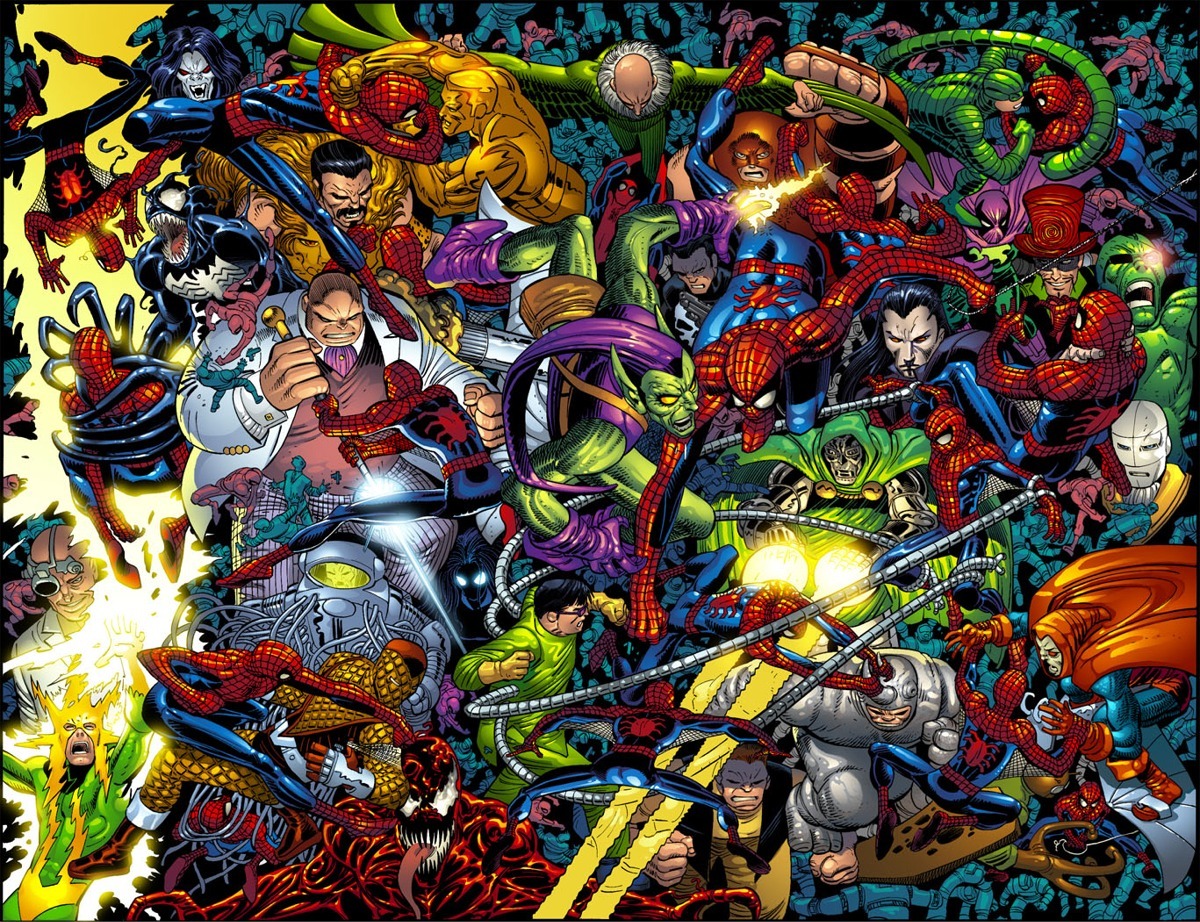
The following are some insights into comics’ super-heroes and protagonists through their evil villains and counterparts.  Sometimes the best way to understand a character is to look into their mirrors.  What foes and villains confound the Fantastic Four, Spider-Man and The Avengers?  How do they resemble their opponents?  And what lessons can we ‘real’ people learn?

Fantastic Four

The villains of the FF are all geniuses who exclusively work alone and use their intelligence for evil.  Mole Man, The Mad Thinker, Diablo, Annihilus, Red Ghost, Psycho-Man and of course Doctor Doom.  These villains shun the use of families or friends, and their minions are either robots, apes, dull-witted super-villains or Moloid drones but never a united team.  Those that have been united, such as the Inhumans, have ended up being the FF’s allies.  I think the story of the FF is how family changes us.  Reed Richards could use his genius intellect to take over the world or at least make billions with his inventions.  The Council of Reeds, a collection of Reed Richards’ from other dimensions, all have proved a major threat to their worlds without their family to root them to the side of good.  Doctor Doom will never conquer the world, he is doomed the fail, for he shuns the company of family (trying to brainwash his adopted son for instance).  However Reed is made stronger by his family backing him up.


Spider-Man

The core of Spider-Man has been responsibility, as handed down to him by his Uncle Ben.  If you have the power, you have to use it.  Unfortunately, plenty of Spider-Man’s foes would disagree, or at the least not use their powers for good.  Doctor Octopus, Sandman, Venom, Electro, Molten Man and key foe Green Goblin were all products of accidents, gaining their powers unintentionally or not realising the full cost of their bargains (Scorpion).  But these villains are villains because they had a choice, sometimes they do good (Will O’ The Wisp, Sandman) mostly, they shun their responsibility.  In life sometimes outside out control we are given options.  What we do with those options is entirely ours, however.  Life throws stuff at us, but it’s out responsibility to either throw stuff back or run and hide.


The Avengers

At the heart of the Avengers is change, difference and variety.  The Avengers have seen through their ranks aliens, mutants, sorcerers, patriots, spies, Gods, scientists, ex-criminals, androids and, most importantly, plenty of ex-villains.  Whilst the Justice League can be defined to perhaps 8-12 specific individuals (all of which heavy-hitters in the DC Universe) the Avengers has a core of 3-4 and the rest a rotating line-up of stock characters who would never (and have never) proved interesting solo characters.  But Hawkeye, Vision, Wonder Man, Scarlet Witch etc etc have all proved to flourish with a larger cast.  And take a look at their enemies, from time-travelling warlords (Kang), evil brothers (Grim Reaper), robots with daddy issues (Ultron), Sons O’ Nazis (Baron Zemo), Asguardian Gods (Loki) and Titans (Thanos).  Their teammates have often fought each other, Yellowjacket becoming a threat to the team, Hulk has fought plenty of members over the years.  The Thunderbolts, a perfect example of how Avengers villains can swap back-and-forth from villainy to heroism.  Things change.  Our enemies can become friends, friends can become enemies.  Those we know and love may become estranged, those we consider strangers might just become our closest friends.


Superman

Supes is the ultimate immigrant.  A being from another world.  Some from a foreign world with strange customs.  Lex Luthor is the big businessman, the politician, the capitalist.  Superman as an immigrant is treated as a threat by Luthor, who feels he must crush this ‘difference’ to reclaim control over America and Metropolis and, indeed, the world.  Superman keeps his culture to himself, his Kryptonian heritage sitting neatly alongside his Kansas upbringing.  Superman is the perfect American, accepting his ‘alien’ background and his role in America, and the perfect example of Kennedy’s “Ask not what your country can do for you” ideology.  A mechanic can offer their skills to America, a Nurse theirs.  Superman, being super-strong, invulnerable and able to fly, offers his powers to the cause of Truth, Justice & The American Way.  Luthor is the establishment, no ideology, no patriotism, no American-idealism.  Just pure control and power wrapped inside legitimate business.  The Superman vs. Luthor dynamic is how you offer your skills in service to, or for, your country.


The Hulk is a tricky one, and requires more thought.  Batman and The Joker/Two-Face/Riddler dynamic has been looked at plenty of times.  The Flash and Green Lantern villains always seem to be common crooks/aliens respectively, with no set ‘theme’, but maybe I need to research more.  Feel free to disagree, millions would.

Little Victories

Little Victories

So we’re coming up to 2 years since the Coalition government was formed and began chipping away at Britain.  They’ve raised tuition fees, cut pensions, attacked strikers, illegalised squatting, forcibly ejected occupations, demonised strikers, incited riots, supported a Workfare scheme, spent billions on the Olympics and the Royal Weddings, cut disability benefits,  evicted a major traveller site, bombed a foreign country, sought to privatise the NHS, education and roads and even taxed our pasties!  Not bad for only a couple of years.

A year ago, we felt this ConDem government was weak.  The student demos has just died down, but the march and occupations on 26th March felt like the activists had really upset the government and the Unions were poised for mobilisation.  Now, it seems people are beginning to accept what they must have done in the early 80s:  The Tories are in, just try and deal with it for x amount of years and vote for Labour next time.  There are still very dedicated activists, Unionists and organisations out there, but it seems nothing large-scale has happened for a while.  Defeatism seems a little too rife.

To combat this, I want to flag up some instances in literature.  I call these Little Victories.  I recently read Arnold Wesker’s Chicken Soup & Barely.  Written in 1956 and revived last year at the Royal Court, the play shows three decades of a small Jewish household in London rooted in Communism.  As the blurb states, “[Wesker thinkers internationally, yet feels domestically” (Kenneth Tyson, The Observer).  1936 is a time for fighting in unity, the first few scenes show the fight back against Mosley’s Black Shirts and the police and a community thriving in left-wing politics.  However despite this, various the struggles, the failures, setbacks and disillusioned ex-comrades mean that by 1956 the family is a splintered, and the movement with it.  The main character, Sarah Kahn, is nursing an old and fragile husband with estranged family and friends.  But despite all this, as Sarah Khan pleads to her son in the final scene, “You’ve got to care or you’ll die”.  As the domestic falls apart, so too has the movement.  But her will still drives on, and her control over what she has left is proof that the movement still has sway.  As long as she is determined to strive on a domestic level, then the battle still continues on the grand scale.


Take another example, Torchwood’s Children of Earth mini-series in which the government of Great Britain send the children with the lowest school test scores as fodder to appease intergalactic alien junkies.  At the very end, one small Welsh estate fights back against their children being taken away, leading to pitched battles in the street.  Whilst all over the country, children are blindly being herded from their suspicious, but passive, parents, at least one small group takes matters into their own hands.  Similarly I recently saw The Hunger Games, and marvelled at the scene where District 11 rise up in anger over the 12-year old Rue being killed for sport.  A little spark can start a fire.

There are various other examples, scenes from Prison Break to She, The Ultimate Weapon and I’m sure countless others, but what I’m getting at is the smaller victories and battles feed into the larger movement.

If there are no large scale protests or action, when there is no giant city-wide event to manage, we must remember to make sure our house is in order.  Wait for the national action, but focus on the local.  Think internationally, feel domestically.  As Al Baker sings “Get to know your neighbours, that’s what it’s all about/we’ll all be a whole lot better when the oil all runs out”.

Small scale action, protests, rallies and organised talks help to build and pin us together.  I’m not saying blindly fight through, jade yourself to defeatism and wear yourself out.  But every little action has a reaction, every little thought and writing and protest does feel into the larger stage.

The activists in York are all on friendly terms, we have a drink together, we chat about politics, we welcome anyone into the little movement.  So when it comes to organising something like Nov 30th or March 26th, it feels like an extended family.  Whether there’s 20 of us on a little protest of 200 outside the Minster or 2000 outside Parliament if we have built this family community during the quieter times, it will sustain us in the radical times.

And a note on Trenton Oldfield who yesterday forced the Cambridge vs. Oxford Boat Race to stop and restart.  Whilst I like a theatrical protest, the problem is his manifesto seems incredibly long-winded.  Him acting alone shows courage and individuality, but unfortunately makes him appear a solo ‘nutter’ without a group or organisation backing him up, which doesn’t help his anti-elitism stance.  Compare to the Disabled People Against Cuts action a few weeks ago.  It was a collective and colourful demonstration against a specific welfare reform with a defiant aim supported by thousands across the country getting a message across.  Trenton’s disruption of the Boat Race sadly does not have this specific aim, only to highlight the elitism of OxBridge and London, something we who follow Boat Races or reports on Boat Races already sort of know.  I don’t necessarily think this is much of a victory for anyone, though he’s along the right lines, but I feel civil disobedience has to have more of a specific aim/target/cause else be backed by a lot more people, else it is washed away by the media, brushed aside by the public and has no longer-lasting tie-in.

Thursday, 15 March 2012

STP #3 (incidental rhyme)

I promise to write a more detailed blog sometime, somewhere, somehow!

In the meantime…

We’re doing #3 of Snapping Turtle Press, submission deadline 23rd March!  We need illustrations, poems, flash fiction, haikus, lyrics, sketches, jokes, stories etc etc.  The theme is 2012…THE END?


Oh and I’m putting on a FREE GIG in York, Stereo, with loads of ace poets, 20th March, see above bar underneath the pic for upcoming gigs J

Sunday, 19 February 2012

Justice League:  Doom

Are Ra’s Al Ghul and Vandal Savage essentially the same person?  Both are international terrorists bent on controlling/dominating the world, made immortal and having seen thousands of years on this planet.  Ra’s was initially conceived as a Batman villain, a hint of the Blofeldian.  Savage is originally a Justice Society of America villain, appearing in 1943 with his schemes for world conquest perhaps not too dissimilar to figures such as Hitler and Mussolini.

Justice League:  Doom, the latest instalment in DC’s animated collection of films, the plotline to Grant Morrison’s Tower of Babel storyline during his exciting run on JLA in the late 90s/early 00s.  The story revolves around the villain Ra’s Al Ghul using methods devised by Batman to take down the World’s Greatest Heroes.  The story revolves around responsibility versus trust; Batman’s methods show his disdain for super-heroes, even if they are his teammates.

Justice League:  Doom fuses this plot with the traditional Anti-Justice League squad consisting of the JLA’s key by arch-enemies formed by Vandal Savage (a stand-in for Ra’s presumably due to Christopher Nolan’s use of the character in his Batman film series).  Apart from the nice use of Bane to replace the traditional Joker and the seldom seen Ma'alefa'ak (Malefic) to combat Martian Manhunter, the line-up of foes is as expected.  Star Sapphire, Mirror Master, Metallo, Cheetah form the traditional rouges gallery of Green Lantern, Flash, Superman and Wonder Woman foes to create The Legion of Doom.


The film is a game of two halves.  The villains trick the JLA into succumbing to Batman’s contingency plans, and engage each villain in delish plots.  Roughly the same techniques are used in Tower of Babel, Flash made to run forever, Martian Manhunter set permanently on fire, Wonder Woman hypnotized to fight forever and Batman’s parents coffins being unearthed.  It’s only through the aide of Cyborg (normally of the Teen Titans) to undo these schemes.  The second half mostly consists of the JLA kicking the Legion of Doom’s ass.

The film is entertaining enough, sometimes a little too much time and energy is spent focusing on the heroes’ downfall, and I wish there were a few more twists and turns in the plot and simply the JA swooping in and kicking the bad guy’s asses.  But nevertheless, it’s good ass-kicking fun.  It’s by no means the same devilry of Luthor in Rock of Ages or World War III storylines, where his insidious schemes leave you flicking back over the pages to double-check just how the villains are winning, and then how the heroes get the upper-hand.  In the 00s TV series by Paul Dini, the episode where Gorilla Grodd formed a Secret Society has a bit more sinister divide and rule, but still not a masterplan.  Nothing compared to Cadmus’ attempts to demolish the League in later series of Justice League Unlimited, but then they had a whole series to build this subplot.  Batman being voted out of the JLA and his stoic defence of his actions it touched upon at the end of Justice League:  Doom but nothing compred to the disgust towards Hawkgirl in Paul Dini’s Starcrossed Three-parter as her loyalties drive her to side with her race instead of her teammates.  This would be explored much further in later episodes, but even within the final conclusion it’s a sad and touching moment, mainly because Green Lantern still loves her after the betrayal.  Batman has no such charm!

It’s always fun to see the Anti-Justice League, whether they’re under the guise of the Secret Society, Legion or Doom, Injustice Gang or the Crime Syndicate.  Each hero usually boils down to a specific arch-enemy or collection or a possible foe, Superman has Luthor, Metallo, Bizarro or Parasite, whilst Flash could go against Gorilla Grodd, Mirror Master or Zoom.

These super-villain teams never last very long, not simply because the super-heroes inevitably defeat them, but the line-up is more fluid, because whilst the heroes are usually a permanent feature, it’s fun to give different villains the line-light.

It’s also interesting to note that Avenger’s opponents (Lethal Legion, Masters of Evil, Squadron Supreme) are not specifically made up of the heroes villains as more a collection of general baddies.  It’s because the JLA has been a collection of the greatest heroes of the DC Universe, Marvel’s top-tier heroes often go solo, Spider-Man, Doctor Strange, Hulk and Daredevil off-and-on team players, X-Men and Fantastic Four obviously their own specific team.  So Beast, Wonder Man, Vision, Quicksilver, Hawkeye never prospered in their own series’, though make decent supporting characters as part of a team.

So think, who might the ultimate villain team consist of, one who not only have the power to take on the World Greatest Heroes but also who have the desire and ambition to take down their arch-enemy?  I think that’s the appeal for a team of villains, they so rarely get together and have a party it’s interesting to see criminals put aside their differences, egos and psychopath-ness in the name of seeing their enemies crushed by their hand.  It’s very traditional, often a tad predictable but always leads to a good old fashion ass-kicking.
Left to right: Bloodshed, Corpse, Gloom, The Dominator, Heatwave, The Reaper, Baron Occult


Left to right top:  The Element, Kestrel, Photus.  Left to right middle:  Swift, The Illusion, The Fake, Doctor Malice, The Reaper, Brute, Talon.  Left to right bottom:  Visor, Python
Left to right:  Nightshade, Frenzy, Gloom, The Dominator, Heatwave, Pyche, Android 1313, Typhoon

Left to right:  Quickflash, Metallic Man, Shadow Knight, Might Man, Commander USA, Arroweye, Warrioress, Insectoid.  None are in any way related to any other characters ever.  Don't sue me.

Saturday, 11 February 2012

Henry, what’s happened in the last month? I shall tell you, dear reader.

What’s happened in the past month?

I did a few gigs with the lovely-voiced Jonny Gill at Duchess and Stereo.  I think David Gest missed my set, so no publicity deal for me.  Check out this Soundcloud clip:  http://soundcloud.com/henryrabypoetry

I went to see John Peel’s Shed which is an entertaining re-imagining of John Osborne’s book into an hour-long account of radio, the love for music and How to Escape A Boring World.  Quaintly British I found.

I went to Manchester to take part in Contact MCR’s Outspoken Slam as part of their Queer Contact festival.  I heard some great queer poetry from Manchestaaa poets and the amazing D’Lo, a stand-up poet from L.A.  Though some pretty stuff competition, I managed to win!  Whey!

I also read a short story at the Leeds Little Fringe, something totally new to make a change from spoken word poetry all the time

But the highlight of 2012 so far has been performing Letter To The Man (from the boy).  It’s my one-man show about growing up, from cartoons, comics, crayons and teenage crushes.  But the key element that makes Letter work is the audience are invited to construct a message to their future selves.  Night #1 & #2 of Leeds were small, intimate and friendly audiences, willing to swap stories sometimes rather intimate histories, but comfortably.  But York’s audience on the 10th really went with the ‘gig’ element, cheering along at times, debating with one another and swapping stories amongst their tables.  I think I hit just the right pitch with this last show, but it’s all down to the friendly, warm and eager crowds that come, so thanks A BAZILLION for everyone who came, and thanks to Humphrey McColl, Rose Drew, Six Lips Theatre & Hedgepig Theatre for their support of the show.


Review of Leeds show:  http://www.leedsstudent.org/2012-02-06/ls2/arts/review-letter-to-the-man-from-the-boy:  "Rabys poetry features a mixture of classic rhyme schemes and the lyrics you’d expect from a Sex Pistols inlay"

If you caught Letter and have any feedback, we’d love to hear how we can improve the show, what bits really work, what don’t or just whether you enjoyed it or not:  henrythepoet@btinternet.com

Thanks y’all!  Find me on Facebook (www.facebook.com/henryrabypoetry) & Twitter (@HenryRabyPoetry)